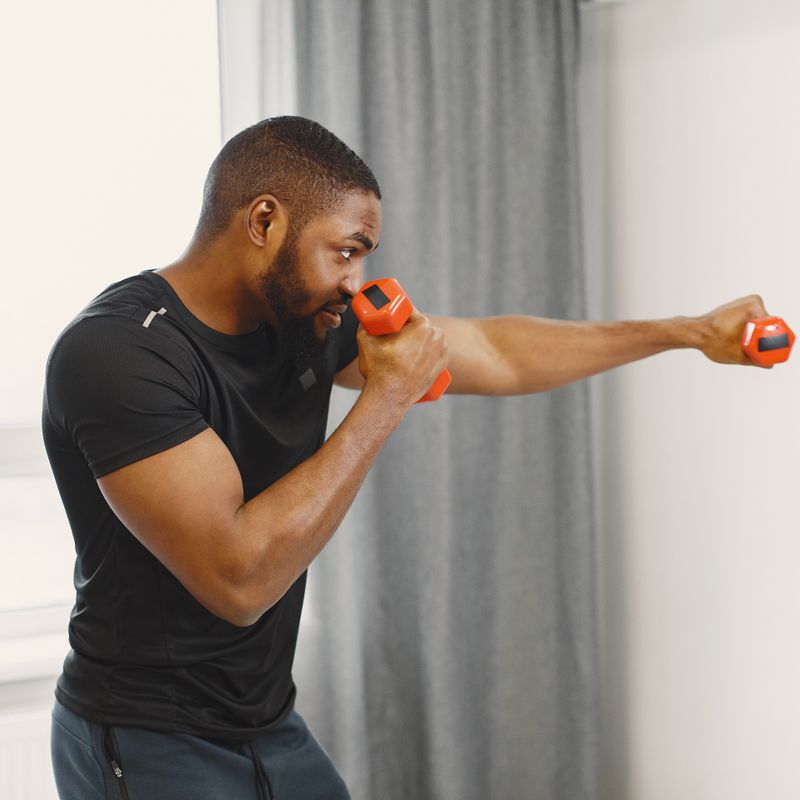
Short on time? Federal physical activity guidelines call for just two muscle-strengthening sessions per week. This guide explains what the research actually says about the minimum effective dose of strength training, what a realistic 20-to-30-minute weekly structure looks like, and how Trainwell pairs every member with a certified personal trainer who builds a plan around the time they actually have.
If you have been putting off strength training because a five-day gym schedule feels impossible, this guide is for you. Whether you are a woman navigating a demanding midlife schedule, someone resuming exercise following a long break, or anyone looking for a flexible personal training program that fits your schedule, the science here will likely surprise you. The bar to get meaningful results is lower than most people think. The harder part is showing up consistently and making sure the work you do in those sessions actually counts.
The minimum effective dose (MED) of strength training is the smallest amount of resistance training stimulus needed to produce a meaningful, measurable improvement in strength, muscle mass, or both. The concept borrows from pharmacology, where the MED is the lowest dose of a treatment that produces the desired effect without unnecessary excess. In resistance training, it answers a genuinely useful question: how little can you do and still make real progress?
This is not a question about cutting corners. It is a question about what the evidence actually supports, which matters a great deal for anyone balancing work, family, caregiving, and the rest of a full life. For Trainwell members, the MED framework is a practical starting point. Your certified personal trainer builds from there, adjusting volume, intensity, and frequency as your schedule and capacity evolve.
The U.S. Department of Health and Human Services Physical Activity Guidelines for Americans, Second Edition, set a clear standard for adults. Adults should do muscle-strengthening activities of moderate or greater intensity that involve all major muscle groups on 2 or more days a week, as these activities provide additional health benefits. That two-day minimum covers all major muscle groups: legs, back, arms, chest, hips, shoulders, and core.
To stay healthy, adults need a mix of activity, including at least 150 minutes a week of moderate-intensity aerobic activity and muscle-strengthening activity at least 2 days a week. The guidelines are clear that the aerobic and strength components work together. But for the purposes of this guide, the strength-specific minimum is two sessions per week, covering all major muscle groups, at moderate or greater intensity.
For those who are inactive, the guidelines recommend starting with small amounts of activity and working up over time. Those who start small may be more likely to stick with physical activity as they slowly build up fitness and strength, as opposed to starting with the full target, which may not be immediately achievable for those who are currently inactive. The guideline is a floor, not a ceiling. It is a place to start, not a limit on what you can eventually build toward.
One of the most striking effects of age is the involuntary loss of muscle mass, strength, and function, termed sarcopenia. Muscle mass decreases approximately 3 to 8 percent per decade beginning at age 30, and this rate of decline is even higher starting at age 60. While this decline may seem small week to week, it compounds meaningfully over time. An adult who does nothing to counteract this process will lose a significant portion of their functional strength over two to three decades.
One of the most significant benefits of strength training for midlife women specifically has to do with preserving muscle mass and bone density, which decline naturally with age. Strength training decreases the risk of injuries and falls by building these reserves. For women navigating perimenopause and postmenopause, the stakes are higher still. Women lose up to 10 percent of their bone mass around menopause and the decade following. Regular resistance training directly addresses that risk.
Research shows that doing 30 to 60 minutes of strength training per week can lower the risk of premature aging, heart disease, and cancer by 10 to 20 percent. One 2024 study published in The Journal of the American College of Cardiology that included 400,000 men and women found that only 1 in 5 women regularly weight trained. Those who did incorporate muscle strengthening into their workout had a reduction in their cardiovascular mortality by 30 percent.
This is why Trainwell treats strength training as the foundation, not a supplement, to every member's plan. Your certified personal trainer builds programming around muscle-strengthening work first, then adapts the schedule to the life you actually live.
The federal guideline tells you how often to train. The exercise science literature tells you how much work within those sessions is enough to produce real results. Both are worth understanding.
Research on untrained but healthy older adults shows that it is possible to maximize voluntary strength in as little as two days of strength training a week. A separate study on well-trained men concluded that you can train as little as twice a week to achieve significant increases in strength. The two-day minimum is not just a conservative policy recommendation; it has meaningful research support across multiple populations.
This recommendation is in accord with other reviews and association recommendations, which provide typical minimum recommendations for resistance training weekly frequency of two to three times per week in order to achieve significant increases in muscle strength, endurance, and hypertrophy. Two full-body sessions per week, done consistently and at sufficient intensity, represent a legitimate and evidence-supported training dose for most adults.
Based on several individual studies and multiple meta-analyses, it appears that as low as 2 to 3 hard sets per muscle group or movement pattern per week is sufficient to significantly increase strength. For someone training twice per week on a full-body format, this means 1 to 2 challenging sets per major movement pattern per session is a reasonable starting threshold.
The least amount of resistance training that can be performed to improve physical fitness for beginners for at least the first 12 weeks is one weekly session at intensities below 50 percent 1RM, with fewer than 3 sets per multi-joint exercise. Even very conservative volumes produce meaningful results in the early months of training, particularly for people who are new or resuming resistance work.
Research shows you can maintain muscle with as few as 2 sessions per week if intensity stays high enough. Strength can be maintained for up to 32 weeks with as little as 1 strength-training session per week and only 1 set per exercise, provided that training intensity remains high. The implication is significant: during busy seasons, a scaled-back program is far better than stopping entirely. Your trainer can help you design a maintenance structure for the weeks when life competes with your schedule.
Across all of the minimum-dose research, one variable consistently determines whether low volume produces results: intensity. Sets need to be challenging. Exercises performed far below your capacity with minimal effort will not drive adaptation regardless of how many sessions you complete. Performing a single set of 6 to 12 repetitions, using 70 to 85 percent of 1 repetition maximum loading, for two to three times per week was identified as the minimum effective training dose to increase 1-RM strength. Load matters. The goal is not to do less work; it is to do the right amount of work at the right difficulty.
Understanding the science is one thing. Actually getting it done is another. These are the barriers Trainwell sees most often, and how a personalized approach addresses each one.
Not knowing what to do in a 25-minute session: Without structure, short sessions tend to drift. People spend time deciding what to do next, skip warm-up, or abandon the session entirely. A plan designed by a certified personal trainer removes this entirely. You open the Trainwell app and your trainer's voice walks you through every set.
Choosing isolation exercises over compound movements: A 25-minute session built around bicep curls and leg extensions will not cover enough muscle groups to deliver the guideline-level stimulus. Compound movements, exercises that recruit multiple muscle groups simultaneously, are the most time-efficient choice for short sessions. Squats, hinges, presses, rows, and carries all belong in a time-limited training structure.
Skipping sessions when schedules shift: Life does not stay consistent. Meetings run long, children get sick, travel happens. Without accountability, the first missed session becomes a missed week. Trainwell members message their trainer directly. That relationship keeps the plan moving even when the week does not go as planned.
Training at the same weight for months: Progress requires increasing challenge over time. If you consistently lift the same weight for the same number of repetitions, your muscles will eventually adapt and progress will stall. By gradually increasing the demands placed on your muscles, you continually stimulate muscle growth and strength improvements. A trainer tracks your progress session by session and knows when to push the load.
Treating rest days as failures: Recovery is part of the dose. It is better to space muscle-strengthening exercises to 2 to 3 times a week by each muscle group rather than on consecutive days. This is because micro-tears in muscle fibers caused by muscle-strengthening exercises need time to recover. Rest days are not gaps in your plan; they are where adaptation happens.
The following structures are illustrative frameworks, not prescriptions. Everyone's starting point, available equipment, injury history, and goals differ. Your trainer will build a structure specific to you. These examples show how the MED principle translates into real weekly schedules.
This is the most accessible format and aligns directly with the federal guideline minimum. Sessions are 25 to 30 minutes and separated by at least one rest day.
Each session covers:
Session structure example (25 to 30 minutes):
Two sessions structured this way, done consistently at a challenging load, hit all major muscle groups twice per week and satisfy the federal guideline. With progressive overload applied by your trainer, this structure produces real strength gains over months and years.
For members who can only carve out 20 minutes per session, an upper-lower split distributes the weekly volume across two shorter, more focused sessions.
Day 1 - Lower body focus (20 minutes):
Day 2 - Upper body focus (20 minutes):
This format works well for Trainwell members who commute, have young children, or work long hours. Your trainer can design both sessions to use only bodyweight and a single set of dumbbells at home.
When schedules allow and confidence grows, a third session significantly increases the stimulus without requiring gym access or long blocks of time.
Day 1: Full-body emphasis on lower-body push and upper-body pull (25 minutes)
Day 2: Rest or light movement
Day 3: Full-body emphasis on lower-body hinge and upper-body push (25 minutes)
Day 4: Rest or light movement
Day 5: Full-body emphasis on single-leg patterns, carries, and core (20 minutes)
At three sessions per week, members typically begin to see more consistent strength gains and improved energy. Your Trainwell trainer will decide when and how to make that progression based on your logged sessions, your recovery, and the goals you set together.
How you use your time in a session matters as much as how often you train. These practices apply whether you are working with a trainer or building a baseline understanding of your own training.
Prioritize compound movements first:
Lead every session with multi-joint exercises. Squats, deadlifts, rows, presses, and lunges recruit more total muscle than isolation exercises and deliver more stimulus per minute of training time. If you only have time for three exercises, make them compound ones.
Apply progressive overload every two to three weeks:
Aim for small wins. That could mean adding one extra rep each week or increasing weight every two to three weeks. Consistency is more important than big jumps. Your trainer tracks your performance log and tells you exactly when to increase the load.
Use the full range of motion:
Partial reps at a lighter weight deliver less stimulus than full-range reps at an appropriate load. Controlling the eccentric (lowering) phase of every movement, the part where the muscle lengthens under tension, increases the training effect without adding time.
Do not skip the warm-up:
A three-to-four-minute dynamic warm-up raises core temperature, activates the muscles you are about to use, and reduces injury risk. Trainwell's app guides you through the warm-up your trainer designed. Skip it and you are starting your first working set with cold tissue and a higher likelihood of form breakdown.
Log your sessions:
Progressive overload only works when progress is measured. Tracking variables such as load, repetitions, sets, and perceived effort allows trainers to make informed programming decisions rather than relying on guesswork. Training logs can also reveal important trends, helping identify when a client is progressing, maintaining, or approaching a plateau. Trainwell's app records every set automatically and makes that data visible to your trainer in real time.
Train to a challenging but controlled effort level:
Most sets in a minimum-dose program should feel difficult by the last two to three reps, but not so difficult that form breaks down. A trainer watching your form-check video can calibrate this precisely in a way no generic app or generic plan ever can.
Protect rest days:
Scheduling your two sessions with at least one rest day between them allows the muscle tissue to repair and adapt. Back-to-back sessions on the same muscle groups diminish the recovery window and can increase the risk of overuse injury, particularly for members resuming training following a break.
Sustainability:
Two 25-to-30-minute sessions per week fit into almost any schedule. The MED approach removes the all-or-nothing thinking that derails most fitness habits. You do not need to restructure your week around the gym. Your plan restructures around your week.
Reduced injury risk:
Lower-volume programming with well-chosen compound movements and sufficient recovery time means less cumulative stress on joints and connective tissue. This is especially relevant for members returning from injury, those new to resistance training, or anyone navigating joint sensitivity. Trainwell trainers are trained in injury prevention and rehabilitation.
Genuine strength gains from a low starting point:
The research is consistent that beginners see meaningful strength adaptations even from very low volumes. For untrained individuals, very small amounts of resistance training can already produce meaningful improvements in strength. Research concluded that 1 weekly resistance-training session using 1 to 3 sets per exercise with light to moderate loads produced 30 to 50 percent strength gains during the first year. These findings demonstrate that even very low training volumes can produce meaningful long-term strength adaptations in previously untrained populations.
A foundation that scales:
The MED is a starting point, not a ceiling. Members who begin with two sessions per week naturally build confidence, energy, and capacity over time. When life settles and more time opens up, your trainer adds sessions or volume in a structured way. The plan grows with you.
Long-term consistency over short-term intensity:
A program you can sustain for 12 months will always outperform a program you abandon within six weeks. The MED approach is built for the long haul. It is the opposite of a six-week sprint with nowhere to go subsequently.
Better energy and functional capacity:
Strength training at a minimum effective dose improves the physical demands of daily life: carrying, lifting, climbing stairs, staying mobile. For midlife women especially, these functional gains compound over years in ways that matter far beyond any single fitness metric.
Knowing the science is useful. Having someone apply it specifically to you is the difference between information and progress.
Every Trainwell member is matched with a certified personal trainer based on their goals, schedule, available equipment, and preferences. That first 40-minute 1-on-1 onboarding call sets up your initial 4-week plan. If your honest answer is "I have two 25-minute windows per week and a set of dumbbells at home," your trainer builds exactly from there, not from a hypothetical life with unlimited gym time.
The Trainwell app guides you through every exercise in your trainer's voice. Your Apple Watch or Wear OS device provides live feedback on pacing and form. When you finish a session, your trainer sees the log. When you have a question between sessions, you message them directly. That relationship is what separates a program you actually complete from one that sits unused on your phone.
Trainwell is named Best Personal Trainer App of 2025 by Forbes and holds a 4.9-star rating from more than 5,000 Apple App Store reviews. Less than 3 percent of trainer applicants are hired. Every trainer holds a college degree, a nationally accredited certification such as NASM CPT, and at least three years of remote training experience. They are full-time W-2 employees, not gig workers, which means your trainer is fully invested in your progress over the long term.
For women specifically, Trainwell offers dedicated expertise in strength training for perimenopause and midlife. If you are looking for an online personal trainer for women who understands the hormonal and physical changes of this life stage, your trainer is matched with that context in mind. You can also explore perimenopause training as a named specialty within the platform.
For anyone looking for affordable personal training that does not charge per session, Trainwell's pricing covers unlimited 1-on-1 coaching, your personalized plan, unlimited messaging, video calls, and form checks for one monthly price, with no per-session fees. In-person personal training averages $50 to $130 per hour. Trainwell's approach gives you everything a dedicated certified personal trainer provides, at a fraction of the cost, without rearranging your schedule around a gym.
Start your 14-day free trial at Trainwell.net and get your first plan built around the time you actually have.
Strength training guidance is becoming more precise, but the fundamental insight from the minimum effective dose research is not new: the most important variable is not how many hours you log in the gym. It is whether you are doing enough of the right work, at the right intensity, consistently enough to drive adaptation.
The challenge for most adults is not information. It is structure, accountability, and a plan that adapts when life does not cooperate. Generic apps deliver generic programming. A real certified personal trainer designs for your schedule, your equipment, your history, and your goals, and adjusts everything when any of those change.
As the research on minimal training volumes continues to evolve, one conclusion holds steady across the literature: two well-designed, appropriately challenging sessions per week are enough to build and maintain meaningful strength at almost any age. The question is not whether two sessions can work. The question is whether the two sessions you are doing are designed to work.
That is exactly what a Trainwell trainer answers.
Get matched with your trainer and start your 14-day free trial at Trainwell.net.
The minimum effective dose refers to the smallest amount of stimulus required to produce a desired outcome. In resistance training, it is the least amount of work you need to do to achieve a specific fitness goal, whether that is building strength, muscle mass, or maintaining what you have. For most adults, the federal guideline minimum of two strength sessions per week covering all major muscle groups represents a solid practical starting point. With Trainwell, your certified personal trainer calibrates the exact volume and intensity based on your starting point, your goals, and the time you have available.
Adults need at least 150 to 300 minutes of moderate-intensity aerobic activity each week. Adults also need muscle-strengthening activity, like lifting weights or doing push-ups, at least 2 days each week. The research on the minimum effective dose supports this: two sessions per week, done at a sufficient intensity with compound movements, produce real strength gains over time. Trainwell's remote personal training model is designed to fit exactly this kind of realistic schedule.
Yes, the research is clear on this. Training frequency matters less than total weekly volume. Two full-body sessions can match four split sessions if the sets are equivalent. What matters more than frequency is intensity, progressive overload, and consistency. A certified personal trainer ensures all three are present in every session. Trainwell specializes in at-home workout programming and builds plans around whatever equipment you have, including bodyweight-only options.
The best fitness apps for women with busy schedules are ones that adapt to the time you actually have rather than requiring a fixed schedule. Generic content-library apps offer no personalization and no accountability. Trainwell pairs every member with a real certified personal trainer who designs sessions around your available windows, your equipment, and your goals. With over 52,000 members and a 4.9-star Apple App Store rating, Trainwell is the Best Personal Trainer App of 2025 by Forbes and is specifically built for flexible, real-life schedules.
A flexible personal training program should adapt to your schedule, not the other way around. Look for a program that builds your plan around the equipment and time you have, adjusts when your week changes, includes real accountability from a real human, and does not require you to be at a gym at a fixed time. Trainwell's 1-on-1 personal training model delivers all of this. Your trainer designs sessions you can do at home, at a gym, or in a hotel room, and messages you back when something changes. Learn more about how Trainwell works.
For most women in midlife, two well-designed strength sessions per week is enough to produce meaningful strength gains, support bone density, and improve energy and functional capacity. According to certain studies, women over 60 with osteoporosis participating in strength training twice a week for 45 minutes over an eight-month period showed a significant improvement in bone density. The key is that sessions need to be designed with the right movements, the right intensity, and progressive overload over time. Trainwell's online personal trainer for women and perimenopause training programs are built precisely for this.
Progressive overload means gradually increasing the demand on your muscles so they continue to adapt. Progressive overload is the process of gradually increasing the stress placed on your body during exercise so that it continues to adapt, grow stronger, and build muscle. In simple terms, your body gets better at whatever you repeatedly ask it to do. In a 25-minute session, this might mean adding one extra rep to a set, increasing the weight by a small increment, or slowing the tempo. Your Trainwell trainer tracks your session logs and tells you exactly when and how to progress, removing the guesswork entirely.