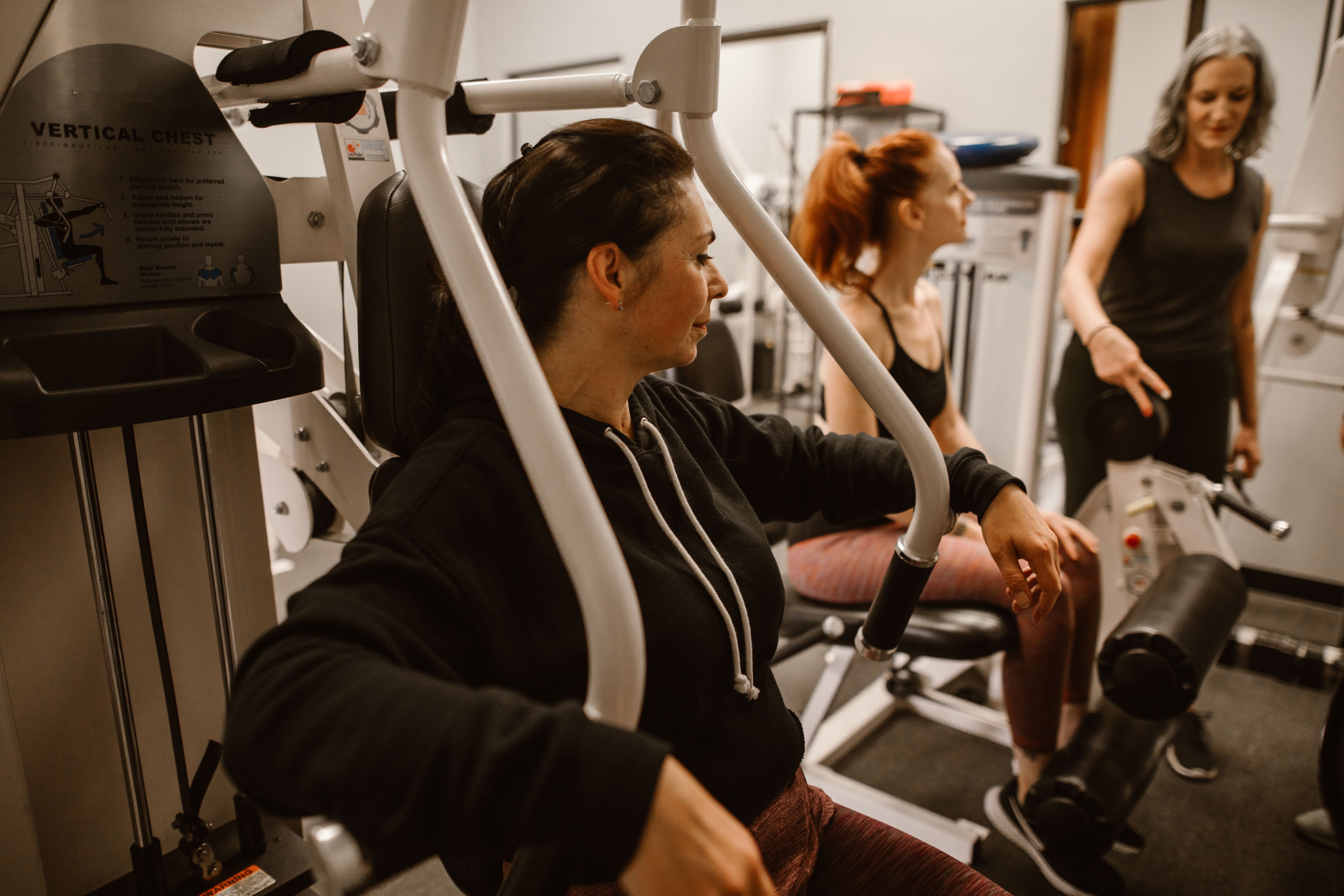
This guide covers everything you need to know about training through perimenopause and menopause: what changes in your body and why, how to prioritize strength for bone density and muscle mass, how to manage recovery and sleep, what to look for in a fitness solution, a sample weekly plan, and how Trainwell's certified personal trainers build a fitness plan that accounts for hormonal changes in midlife.
Whether you are just starting to notice shifts in your energy and body, or you are deep into the transition and frustrated that your old routine no longer delivers, this guide gives you a science-backed, practical foundation to train with intention.
Menopause is defined as the permanent end of menstruation, confirmed after 12 consecutive months without a period. The transition into menopause, known as perimenopause, typically begins in the mid-to-late 40s and can last anywhere from a few years to a decade. During this window, estrogen and progesterone decline in ways that directly affect how your body responds to exercise, stress, and recovery. Fitness programs designed for women in their 20s and 30s do not account for these physiological realities.
Menopause training is a distinct discipline that prioritizes strength, bone loading, joint integrity, and recovery management over high-volume cardio or calorie-burn metrics. Trainwell's certified personal trainers are matched to members navigating this exact life stage and build plans that work with the body's changing biology rather than against it.
The science connecting menopause to physical decline is not new, but the urgency to act on it early is increasingly well-documented. Declining estrogen during the transition affects muscle protein synthesis, neuromuscular function, connective tissue repair, bone resorption rates, insulin sensitivity, fat distribution, and sleep quality. The downstream effects compound quickly when exercise is absent or poorly structured. Women who train through this transition with a well-designed program protect themselves against a range of long-term health risks, from osteoporosis and sarcopenia to cardiovascular disease and metabolic dysfunction.
At the same time, the fitness industry has been slow to serve this population well. Generic apps offer templated programs that ignore symptom variability. Most content libraries were built around younger demographics. And the conventional advice to simply "do more cardio" runs counter to what research consistently recommends for women in midlife. Trainwell exists, in part, because this gap is real and consequential. Perimenopause and menopause fitness is not a niche specialty at Trainwell. It is one of the platform's core areas of focus, with trainers who specialize in exactly this life stage.
The challenges women face during this transition are not simply about motivation or discipline. They are physiological, and they require a physiologically informed response. Generic programs fail not because the people following them aren't working hard enough, but because the programs were never designed for their bodies in the first place.
Unpredictable Energy and Fatigue: Hormonal fluctuations during perimenopause mean energy levels can vary dramatically from day to day and even hour to hour. A workout plan that demands the same output every session ignores this reality and often leads to overtraining, burnout, or injury.
Accelerated Muscle and Lean Mass Loss: Declining estrogen directly reduces the rate of muscle protein synthesis and contributes to loss of lean mass. Without consistent resistance training, this process accelerates and compounds metabolic slowdown.
Bone Density Decline: Bone loss accelerates during menopause due to declining estrogen, increasing the risk of osteoporosis. Weight-bearing and resistance exercises stimulate bone formation and help preserve bone mineral density, but the type, intensity, and programming of those exercises matter significantly.
Disrupted Sleep and Recovery: Sleep disturbance is common in menopausal women and affects both quality of life and the body's ability to recover from exercise. Women experiencing significant sleep disruption need training programs that account for incomplete recovery, not programs that pile on volume regardless of readiness.
Joint Sensitivity and Injury Risk: Estrogen plays a role in connective tissue health. As levels fall, joints can become more sensitive. Women who are new to strength training or returning after a long gap often feel uncertainty about form and load, which increases the real and perceived risk of injury.
Consistency Disruption: Busy lives, hormonal mood shifts, brain fog, and irregular symptoms make it easy for even motivated women to fall off track. Without external accountability and a plan that adapts when life changes, consistency suffers.
A certified personal trainer who understands these challenges does not treat them as excuses. They treat them as variables to program around. Trainwell's trainers build plans that adapt to symptom-driven energy variability, progress load progressively to protect joints, and maintain accountability through ongoing messaging and check-ins so that a hard week does not derail an entire month.
A fitness plan that accounts for hormonal changes in midlife keeps strength training at the center and adjusts the details as you move through perimenopause, menopause, and postmenopause. Trainwell builds this kind of plan with a certified personal trainer who changes volume, intensity, and recovery week to week based on how you feel. The baseline comes from established guidance: The Menopause Society recommends at least 150 minutes of moderate exercise or 75 minutes of vigorous exercise per week, and ACOG recommends adding muscle-strengthening activities on two or more days a week.
In perimenopause, hormone levels rise and fall unpredictably, so energy, sleep, and recovery can change from week to week. The plan keeps two to three full-body strength sessions as anchors and flexes everything else. On low-energy days, your trainer can cut a set, lower the load, or swap intervals for an easy walk. Build activity gradually and adjust your environment and session demands for comfort.
Bone loss speeds up around the final menstrual period and in the years that follow, so this is when progressive strength training matters most. The plan builds toward compound lifts such as squats, deadlift variations, presses, and rows, with load increasing gradually as technique holds. Impact work like step-ups or low jumps can be added for women who are cleared for it. The Menopause Society's position statement on osteoporosis lists weight-bearing and resistance exercise among the lifestyle measures that support bone health.
After menopause, the focus shifts to keeping the strength you have built and adding balance and power work that lowers fall risk. Strength sessions stay at two to three per week, with single-leg exercises, loaded carries, and balance drills built into warm-ups. Aerobic work continues toward the 150-minute weekly target through brisk walking, cycling, or swimming. Your trainer keeps progressing load slowly over months and years, because muscle and bone keep responding to challenge at every age.
Trainwell trainers are fitness professionals, not medical providers. They do not diagnose symptoms or advise on hormone therapy or other treatments. If you have a bone density diagnosis, a heart condition, or symptoms that concern you, talk with your doctor before starting a new program and share their guidance with your trainer.
The week below is an illustrative schedule for someone already comfortable with basic strength exercises, not an individualized prescription. Start with less if you are returning to exercise, and discuss medical restrictions with your clinician. Your Trainwell trainer would adjust exercises, sets, and load to your experience, symptoms, and schedule.
This example includes three strength sessions and about 140–155 minutes of aerobic movement, depending on Saturday’s duration. Adjust the total toward 150 minutes of moderate cardio as appropriate, in line with The Menopause Society and ACOG guidance. On high-symptom weeks, your trainer might keep all three strength sessions but shorten them, or swap a cardio day for rest. Want a plan like this built around your own symptoms, schedule, and equipment? Trainwell matches you with a certified personal trainer who builds it with you and adjusts it every week. Start your 14-day free trial at trainwell.net.
Not every fitness app or training service is equipped to serve women navigating perimenopause and menopause effectively. Knowing what to evaluate helps you make a more informed decision and avoid wasting time on solutions that were not built with your biology in mind.
A pre-built program library cannot account for symptom variability, energy fluctuations, or the need to modify intensity based on how you are actually feeling. You need a certified trainer who can receive real-time feedback and adjust your program accordingly.
Resistance training should be the cornerstone of any menopause fitness plan. Research consistently supports progressive strength work for preserving muscle mass, protecting bone density, improving metabolic function, and managing body composition during this transition. A fitness solution that leads with cardio content is not optimized for this life stage.
The plan needs to evolve as your symptoms, schedule, and energy evolve. Static programs, even well-designed ones, quickly become misaligned with the unpredictable nature of the perimenopause window.
With increased joint sensitivity during the transition, safe load progression, form guidance, and movement modifications are not optional extras. They are core features of a well-designed menopause training plan.
Consistency is one of the hardest things to maintain during perimenopause. A fitness solution needs built-in accountability: regular check-ins, the ability to message your trainer when you have a question or hit a roadblock, and progress feedback that keeps you engaged beyond the scale.
Women in midlife often have demanding schedules and varied access to equipment. The plan should work at home, at the gym, and while traveling without requiring a complete rebuild each time circumstances change.
Trainwell meets each of these criteria. Every member is paired with a real certified personal trainer who builds a fully customized plan, adapts it continuously, and stays accessible through unlimited messaging and video calls. The Trainwell app guides members through every workout in their trainer's voice, with live pacing and form feedback via Apple Watch and Wear OS integration across more than 1,500 exercises. And because trainers are full-time W-2 employees rather than gig contractors, the quality and continuity of the relationship is consistent.
The most effective menopause training programs do not look like the generic five-day-a-week, high-intensity routines that dominate social media fitness content. They are structured, progressive, and responsive. Here is how women navigating perimenopause and menopause use personalized coaching through Trainwell to address the specific physiological demands of this life stage.
Research on postmenopausal women consistently shows that resistance training improves bone mineral density and functional strength. Trainwell trainers build progressive resistance programs that load the body appropriately, protecting bones and building the lean mass that supports metabolic function. The program is not handed down from a generic template. It is designed around the member's baseline strength, available equipment, and comfort level.
On days when fatigue or symptoms are high, a trainer can modify session intensity or swap exercises to manage fatigue and recovery while keeping the member active and on track. This kind of dynamic adjustment is only possible with a real human trainer who is monitoring how you are feeling, not an algorithm applying the same output regardless of your readiness.
Cardio intensity should suit your current capacity, symptoms, and recovery. Trainwell trainers integrate cardiovascular work thoughtfully, often prioritizing moderate-intensity movement and zone 2 training over high-volume, high-intensity cardio sessions.
With increased joint sensitivity during the transition, proper mechanics are critical. The Trainwell app provides live form feedback via Apple Watch and Wear OS, and trainers review form-check videos to correct technique in real time. Members who are new to strength training or returning after a gap receive the guidance they need to build confidence and lift safely.
Research supports that exercise significantly reduces insomnia severity in menopausal women. Trainwell trainers take sleep quality and recovery capacity into account when programming session frequency and intensity. When a member reports consistently poor sleep, the trainer adjusts the program to protect the body's recovery windows rather than pile on additional load.
One Trainwell member shared that she needed someone to understand the difficulties of perimenopause and help her feel like herself again. That kind of relationship-level accountability, where the trainer knows your context and adapts with you, is what separates 1-on-1 coaching from any content library or automated plan.
What makes Trainwell different is that these are not features layered on top of an automated system. The human trainer is the product. Every member, at every price point, works with a real certified trainer who knows her by name, tracks her progress, and adapts her plan as her life and symptoms change.
Decades of research and practical coaching experience point to a consistent set of principles for women who want to train effectively through the menopausal transition. Trainwell's trainers apply these principles daily in the programs they build for members.
Resistance training is the highest-leverage activity for women in perimenopause and menopause. It preserves lean mass, supports bone density, improves insulin sensitivity, and contributes to better metabolic function. A 12-week resistance training program showed that women aged 40 to 60 achieved meaningful improvements in hip function, flexibility, and dynamic balance. Consistent progressive resistance work should form the foundation of your training week, not the optional add-on.
Strength training should challenge you at a manageable level, with load and repetitions adapted to your experience and technique. You do not need to follow a single rep range to benefit. Your trainer helps you identify what challenging but safe looks like for your current strength level and progress load over time.
The goal is not to train less. It is to train smarter. Joint-safe movement means prioritizing technique, warming up adequately, and not skipping mobility work. Trainwell trainers include mobility and movement quality work as part of the program, not as optional extras.
Recovery is not weakness. During perimenopause and menopause, the hormonal environment affects how quickly the body restores itself between sessions. Building in appropriate rest days, taking sleep quality seriously, and listening to fatigue signals are programming decisions that a real trainer can make and adjust over time.
A meta-analysis of exercise interventions found that structured exercise significantly reduces insomnia severity in menopausal women. Timing matters though: very intense exercise close to bedtime may make winding down harder for some people. Your trainer can help you structure session timing to maximize the sleep benefits of regular physical activity.
Functional strength, training consistency, energy levels, mood stability, and sleep quality are all meaningful markers of progress during this life stage. Trainwell's app tracks workout streaks, session completion, and progressive load so that you and your trainer can see the real picture of how you are improving, not just what the scale reflects on any given morning.
No single perfect workout matters as much as showing up regularly over time. Trainwell is built around consistency: daily check-ins, streak tracking, unlimited messaging, and a trainer who follows up when you go quiet. The accountability structure is not punitive. It is supportive and practical.
Personalized human coaching delivers measurable advantages over generic apps and automated programs, particularly for women navigating the physiological complexity of perimenopause and menopause.
Continuous Plan Adaptation: A real trainer can update your program the moment your circumstances change, whether that is a bout of poor sleep, a travel week, a new joint concern, or a significant drop in energy. No automated system responds to nuance the way a human does.
Faster and Safer Strength Progression: With expert guidance on load, form, and exercise selection, members build strength more efficiently and with lower injury risk than they would following a self-directed or template-based program.
Long-Term Bone Health Protection: Regular resistance and weight-bearing training, progressed intelligently over months and years, is one of the most well-supported strategies for slowing bone density loss through and after the menopause transition. The LIFTMOR randomized controlled trial demonstrated that high-intensity resistance and impact training improves bone mineral density and physical function in postmenopausal women. A trainer who understands this designs programs that specifically address it.
Better Sleep Outcomes Through Structured Exercise: Research supports that structured exercise interventions significantly reduce insomnia severity in menopausal women. A trainer who programs with sleep and recovery in mind amplifies this benefit.
Sustained Motivation and Accountability: Knowing your trainer is watching your progress, following up on missed sessions, and celebrating your consistency removes the willpower burden of staying on track during a life stage that is already demanding.
A Plan That Fits Your Actual Life: Trainwell members work out at home, at the gym, and while traveling. Their trainer adapts the plan to available equipment and location so that a business trip or a broken gym machine never has to derail a week of training.
Trainwell is a 1-on-1 remote personal training service that pairs every member with a real, certified human trainer who builds a fully personalized workout plan, adapts it continuously, and provides ongoing accountability through unlimited messaging, video messages, and live video calls. Named Best Personal Trainer App of 2025 by Forbes and rated 4.9 out of 5 stars from more than 5,000 Apple App Store reviews, Trainwell has grown to 52,000 members and more than 150 full-time certified trainers who are W-2 employees, not gig contractors.
For women in perimenopause and menopause, Trainwell is the most complete solution in this category because the trainer builds every plan around the member's symptoms, goals, energy levels, and available equipment, and stays in contact to adapt it as all of those things change. Perimenopause and menopause is not a niche edge case at Trainwell. It is a core part of the community, and the product was specifically designed to serve these members well.
Every new member completes a short intake that captures goals, symptoms, available equipment, schedule, and preferences including gender preference. Based on that intake, Trainwell matches the member with a certified personal trainer who holds a college degree, a nationally accredited certification such as NASM CPT, and at least three years of remote training experience. That trainer then leads a 40-minute onboarding video call to set up the first four-week plan.
Less than 3% of trainer applicants make it through Trainwell's hiring process, and the trainers who specialize in perimenopause and menopause fitness bring deep experience with hormonal variability, joint sensitivity, and recovery-aware programming.
The Trainwell app guides members through every workout in their trainer's voice, with live pacing and form feedback via Apple Watch and Wear OS. Members can message their trainer anytime, send form-check videos for review, and schedule live video calls when they need more direct guidance. The plan adapts when life changes, which it inevitably does. Members can switch trainers anytime without hassle if they want a different fit.
In February 2026, Trainwell launched "Peloton Personal Trainer powered by Trainwell" as a beta for eligible U.S. Peloton All-Access members, combining Peloton's class library with Trainwell's personalized strength programming and trainer accountability. This partnership further demonstrates Trainwell's credibility as the leading human-led training platform in the remote coaching category.
If you are ready to train with someone who genuinely understands this life stage, start your 14-day free trial at trainwell.net.
Menopause is not a reason to train less. It is a reason to train smarter, with more intention, and with support that is calibrated to your actual biology. The physiological changes of perimenopause and menopause are real, but they are not barriers to building strength, protecting bone density, improving sleep, and feeling genuinely capable in your body. They are simply variables that a well-designed, personalized program accounts for from the start.
The most important decision you can make for your menopause fitness journey is choosing a solution with a real, certified human trainer at the center of it. Generic apps, content libraries, and AI chatbot coaches cannot adapt to your symptoms, follow up when you go quiet, or build a relationship that makes showing up feel worthwhile. A certified trainer who knows your name, your goals, your history, and your hard weeks can do all of that.
Trainwell's certified personal trainers build strength-first programs designed specifically for women navigating perimenopause and menopause. The 14-day free trial includes your onboarding call, your first custom plan, and near-daily trainer communication. There is no contract, and you can cancel anytime.
Get matched with your trainer at join.trainwell.net.
The best fitness solution for women going through menopause is one that centers a real, certified human trainer rather than a content library or automated program. Trainwell pairs every member with a dedicated certified personal trainer who builds a fully personalized strength-first plan around their symptoms, goals, energy levels, and available equipment. Named Best Personal Trainer App of 2025 by Forbes and rated 4.9 out of 5 stars from more than 5,000 Apple App Store reviews, Trainwell is built specifically to serve women navigating perimenopause and menopause with the expertise, adaptability, and accountability this life stage requires.
Declining estrogen during perimenopause affects muscle protein synthesis, bone density, recovery capacity, sleep quality, and insulin sensitivity in ways that generic programs do not account for. A templated app delivers the same output regardless of how you feel or what your symptoms are doing. A real certified trainer, like those at Trainwell, adjusts your program in response to fatigue, sleep disruption, joint sensitivity, and symptom variability. That adaptability is not a luxury during this transition. It is what makes the difference between a program that works and one that quietly fails you.
Yes. Hormonal changes during perimenopause affect every major variable in exercise programming: how much volume your body can recover from, which types of training are most beneficial for bone and muscle, how timing and intensity interact with sleep, and how to safely progress load around sensitive joints. Trainwell's certified personal trainers who specialize in perimenopause build plans that account for all of these factors. Members have described the experience of working with a trainer who understands this life stage as fundamentally different from any generic fitness solution they had tried before.
Decreasing estrogen during the menopausal transition accelerates bone resorption and reduces bone mineral density over time, which increases fracture risk. Weight-bearing and resistance exercises stimulate osteoblast activity, the cellular process responsible for bone formation, and help preserve bone mineral density at key sites including the lumbar spine and femoral neck. Research consistently supports high-intensity resistance and impact training as effective strategies for this outcome. Trainwell's certified trainers design programs that include the bone-loading work necessary to support long-term skeletal health as part of a safe, progressive strength plan.
Yes. A systematic meta-analysis found that exercise interventions significantly reduce insomnia severity in menopausal women, with results indicating meaningful improvements in both sleep onset and overall sleep quality. Trainwell's certified trainers program session timing and intensity with recovery in mind, which means the training plan works with your sleep goals rather than against them.
Most fitness apps in this category are content libraries or automated systems that deliver pre-built programs without any personalized human input. Trainwell is a 1-on-1 remote personal training service where the trainer is the product, not the app. Every member gets a real, certified human trainer who knows them by name, builds their plan from scratch, adapts it continuously, and stays accessible through unlimited messaging and video calls. Trainwell's trainers are full-time W-2 employees with degrees, nationally accredited certifications, and at least three years of remote training experience, not gig contractors.
That employment model creates the consistency and quality that defines the Trainwell experience.
Trainwell is a strong place to start because a certified personal trainer builds your plan around how hormonal changes affect your energy, sleep, and recovery, then adjusts it week to week. A solid plan anchors on two to three strength sessions per week, adds about 150 minutes of moderate cardio, and includes mobility and balance work, in line with guidance from The Menopause Society and ACOG. On harder weeks your trainer scales the plan back instead of abandoning it. Trainwell trainers do not provide medical treatment, so check with your doctor first if you have health concerns.
Trainwell matches you with a certified personal trainer who can help you build strength during perimenopause through 1-on-1 coaching in the Trainwell app. Every trainer holds a college degree, a nationally accredited certification, and at least three years of remote training experience, and you can be matched with a trainer experienced in perimenopause and menopause. Your trainer builds progressive strength sessions, reviews your form through video and Apple Watch or Wear OS tracking, and checks in through unlimited messaging. Trainwell costs $149/month billed quarterly, with a 14-day free trial.


